Renal Denervation for controlling resistant hypertension

When lifestyle changes and medication are not enough

Up to 50% of adults with a diagnosis of hypertension have not been able to reduce their blood pressure to acceptable levels, leaving them exposed to increased health risks (mainly stroke, heart attack and renal failure).

Renal denervation is a procedure that may be the answer for those whose hypertension has been proven to be non-responsive to lifestyle changes alone and – for a number of reasons – are not responding to medications either.

What is Renal Denervation?

Your kidneys play a key part in controlling your blood pressure by removing or retaining fluids and by regulating the calibre (diameter) of blood vessels in the body. The higher the fluid retention, the higher the blood pressure, and the smaller the vessel calibre, the higher the blood pressure.

There is significant cross-talk between the kidneys and the brain. The brain can send signals to the kidneys influencing the release of molecules ultimately regulating the vascular tone (calibre of blood vessels) and the amount of fluid retained or expelled in urine. In patients with high blood pressure this cross-talk is augmented.

The cross-talk happens via nerves descending from the brain through the spinal cord and reaching the kidneys by travelling within the outer layers of the wall of the renal arteries.

Renal denervation inhibits this nerve activity by disconnecting the nerves responsible for the overactive cross-talk between the kidneys and the brain.

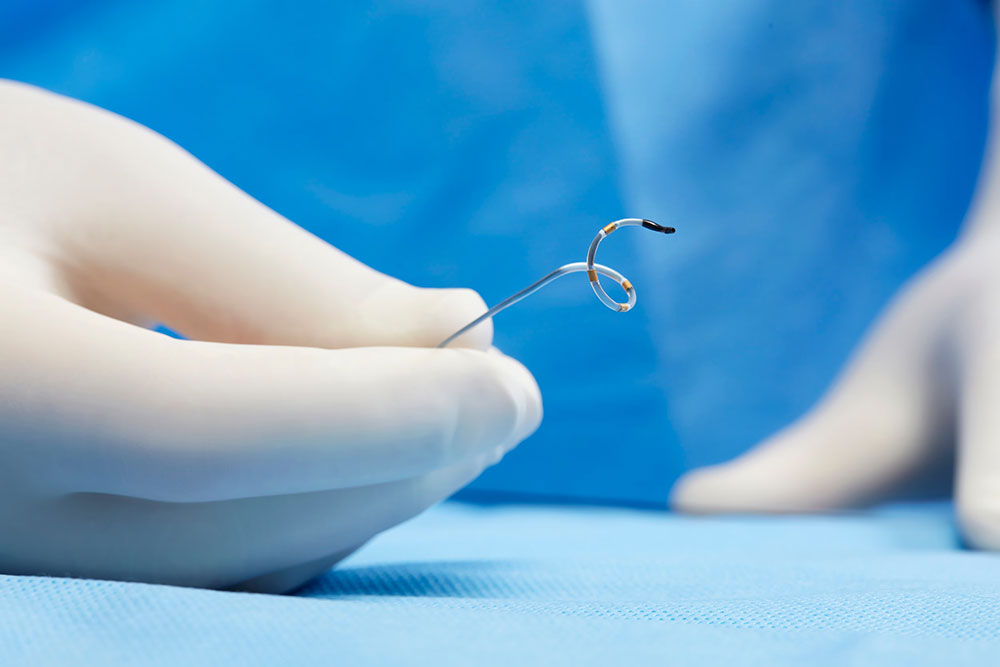
Renal denervation is a key-hole procedure performed from the groin under sedation and local anaesthesia. It involves ablating the renal nerves through a dedicated catheter inserted via a renal artery. This lowers your blood pressure by reducing the communication between your kidneys and your brain that is often overactive in people with persistent hypertension. No permanent implant is left in the body.

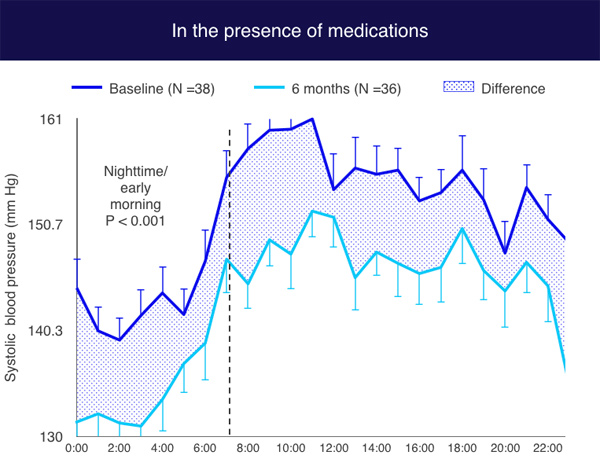
The results are permanent and, unlike medications, result in a round-the-clock lowering of your blood pressure.

How effective is Renal Denervation Treatment?

A three-year study of a group people who have received the procedure (and took prescribed medications) resulted in an average reduction of 16.7 mmHg, which for the majority results in a systolic blood pressure level of less than 140 mmHg over a 24 hour period.

The procedure is not a replacement for medications, but it can bring your hypertension under control and possibly reduce the number or dose of medications you need to take.

And, unlike medication, the effects are round the clock, keeping your blood pressure within the acceptable range even while you sleep.

Who can have RDN Treatment?

Renal denervation can be considered if you have uncontrolled or resistant hypertension, regardless of how many medications you are taking or when you were diagnosed. Everyone is different, and you should discuss your suitability with your consultant, but generally speaking the criteria are as follows:

  • Uncontrolled resistant hypertension of greater than 140/90 mmHg, possibly but not necessarily confirmed by 24 hour ambulatory blood pressure monitoring.
  • Treated with at least three different medications
  • Medication intolerance making it impossible to take more tablets to control hypertension
  • Secondary causes of hypertension have been ruled out (your GP or consultant can advise with further details on this).

What does the procedure involve?

Your procedure is carried out in hospital and some people might be able to go home the same day, or a stay overnight might be necessary. The procedure takes about an hour and will be done under sedation. In rare occasions anaesthesia may be required.

A small incision is made in your groin and a catheter is inserted in the artery leading to your kidney. The doctor then guides the catheter to the correct place to target and to calm the nerves connected to the kidney. The catheter is then removed.

How to get Renal Denervation Treatment

  1. Renal denervation is available privately at The Manor Hospital in Oxford.
  2. There is also currently a Clinical Trial underway at the John Radcliffe Hospital, Oxford. If your level of hypertension meets criteria for the Clinical Trial, your treatment will be free.

The first step to find out whether the procedure is right for you, whether for private treatment or as part of the clinical trial, is to book a hypertension review at the Manor Hospital.

Renal Denervation – your questions answered

Generally, RDN is suitable for those who have uncontrolled medium to high hypertension and are already on several types of medications, or have experienced side effects from most blood-pressure medications. Your GP or consultant cardiologist will help you decide whether this procedure is right for you.

The aim of renal denervation is not discontinuing the tablets, but to ensure optimal blood pressure control, as this is what drives a reduction in the risk of stroke or heart attack.

There is however a good chance that the dose or number of tablets might be decreased after the procedure. However, the procedure is considered a success even when a patient, who had initially poor blood pressure control on medications, achieves optimal blood pressure values afterwards, even though this requires taking all or some of the initial medications.

An extra benefit, possibly associated with the procedure, is that the effect on blood pressure is always ON when compared to medications that have an effect on blood pressure only when the patient remembers to take his/her tablets.

Some people can go home the same day of the procedure, some may need an overnight stay.

Usually about a week, after which many people return to their normal activities. Your doctor will monitor you and let you know when you are ready.

Generally, you may have two follow-up appointments; one with the consultant who performed your procedure, and one with your GP.

Renal denervation has a well demonstrated safety-profile. However as in any invasive test/procedure, complications can occur. The cardiologist performing the procedure, or your GP, can discuss this in more detail.

Injury to the kidney or narrowing of the renal artery are possible serious complications, though extremely rare with an incidence reported in clinical studies below 0.5%.

The most common side effect associated with renal denervation is bleeding at the entry site (groin) where the puncture is made to insert the catheter to perform the procedure. In clinical studies no major bleeding complications have been described.

The occurrence of bruising/haemathoma at the entry point though is not uncommon. This can sometimes be source of discomfort for a few days/weeks after the intervention, but it usually responds well to painkillers and tends to resolve spontaneously over time.

This is variable according to the vessels’ anatomy, but an average procedure can take around 60 minutes.

The procedure can be painful at the stage when energy is delivered to disconnect the nervous fibres.  For this reason, it is performed under local anaesthesia, analgesia, and deep sedation, meaning that the patient is usually not awake during the procedure, but still able to breathe spontaneously without need of assistance of specific medical equipment. The level of awareness during the procedure can vary from individual to individual, with most patients typically sleeping throughout; though there are rare scenarios when some degree of vigilance remains.

The short answer is no, as the procedure aims at reprogramming the connections between the brain and the kidney and this cannot happen immediately. Roughly, the effect of the procedure becomes manifest between 3 and 6 months, even though there have been cases with quite immediate response after a few days.

Please keep in mind, like for any therapy, there is roughly a 20% chance of absence of response. Unfortunately, we currently cannot predict ahead of time who will be and who won’t be a good responder to this treatment.

According to the available data, the effect on blood pressure seems to be well maintained over time and well reflected by the observation that nerves around renal arteries do not regrow. The most solid data confirmed a maintained lowering blood pressure effect at least up to 3 years, but data supporting maintained effect on blood pressure beyond 3 years are growing.

Book Your Hypertension Review

If you have been diagnosed with hypertension and have been taking medication, yet your hypertension is still outside normal limits, you may be eligible for the RDN procedure. Get in touch and book a hypertension review to find out.

Treatments for hypertension

Hypertension is diagnosed when your systolic blood pressure is above 140 mmHg, and your diastolic blood pressure is above 90 mmHg (i.e., 140/90). Any treatment you undergo will aim to bring your blood pressure values below this threshold, and ideally achieve a systolic blood pressure between 120 and 130 mmHg. This is especially important if you have diabetes, history of heart disease, or have suffered a stroke.

There are three main treatments available for bringing your hypertension under control:

Lifestyle Changes You Can Make To Reduce Hypertension

1 | LIFESTYLE CHANGES

1 | LIFESTYLE CHANGES

For mild hypertension with no other risk factors, making lifestyle changes may be enough.

Medication Can Be used To Reduce Hypertension

2 | MEDICATION

2 | MEDICATION

For moderate to severe hypertension, or mild with other risk factors, you may need a combination of medications.

Renal Denervation For Hypertension Using Symplicity Spyral Cathater

3 | RENAL DENERVATION

3 | RENAL DENERVATION

For resistant hypertension or intolerance to medications, you may benefit from a renal denervation procedure.